Lab · Electronics
Diodes, LEDs and solar cells
The semiconductors that make light and catch it.
- A simulation bench
- Chapters
- A guided tour
- Challenges
The short answer
How does an LED work?
An LED is a diode: two layers of semiconductor stuck together, one rich in electrons, the other rich in “holes”, which let current through in one direction only. In that direction, electrons cross the junction and can fall into a hole, releasing their energy as a grain of light, a photon. Its colour depends on the energy of that fall, set by the material of the chip.
With the Family plan
- They understand what they see in class. Every maths and science idea becomes an experiment they get their hands on.
- They get going on their own. A hint when they get it wrong, the solution only after three tries.
- You see what they did. Mission by mission, in your parent space.
No bank card. Afterwards: €6.90 a month, no commitment · or €49 a year
Cancel online at any time, effective at the end of the paid month. Terms of sale
- Your account
- Your e-mail confirmed
- The course, straight away
The plan opens every course: 247 workshops, 117 modules and 49 labs, from age 9 to university level.
See the plans →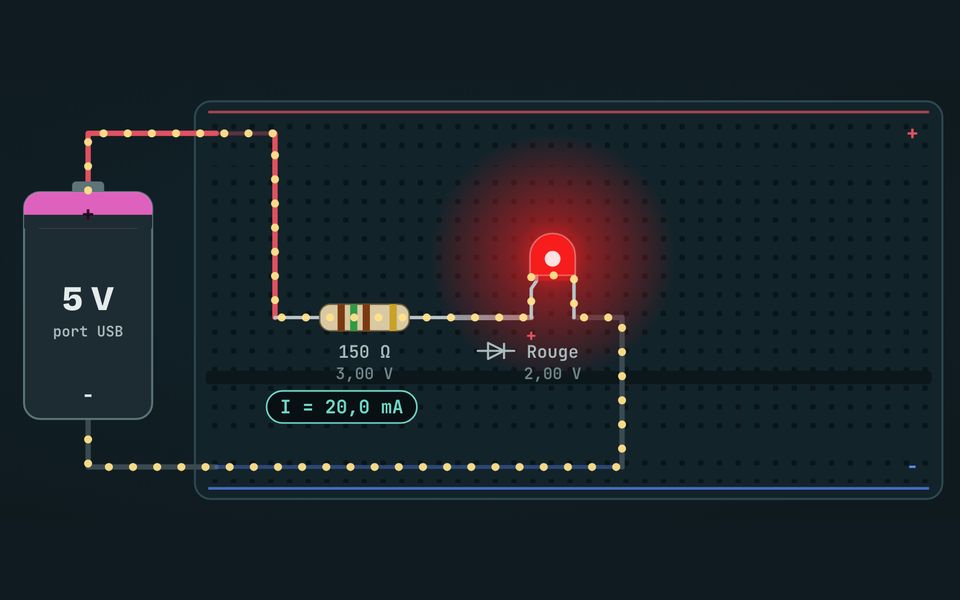
Already have an account? Sign in
Teacher? A free 2-month trial for your class. Write to us
- Card payment, on Stripe’s secure page
- No ads, no data sold
- Data stored in France