High school and beyond · Mathematics · Tle · ages 17 to 18
The geometric distribution: how many tries before the first success?
Try again until the first success: the distribution of the number of tries, its mean 1/p, and why chance has no memory.
- ⏱ 20 to 30 min
- 8 missions
- 3 levels: discover, understand, go further
The short answer
How many tries does it take to get the first success?
It depends on chance: sometimes very few, sometimes many. But if each try succeeds with the same probability p, independently of the earlier ones, the number of tries follows a precise law, the geometric distribution. You can then calculate the probability that exactly k tries are needed, and the average number of tries, which is larger when p is smaller.
With the Family plan
- They understand what they see in class. Every maths and science idea becomes an experiment they get their hands on.
- They get going on their own. 20 to 30 min: a hint when they get it wrong, the solution only after three tries.
- You see what they did. Mission by mission, in your parent space.
No bank card. Afterwards: €6.90 a month, no commitment · or €49 a year
Cancel online at any time, effective at the end of the paid month. Terms of sale
- Your account
- Your e-mail confirmed
- The course, straight away
The plan opens every course: 244 workshops, 114 modules and 49 labs, from age 9 to university level.
See the plans →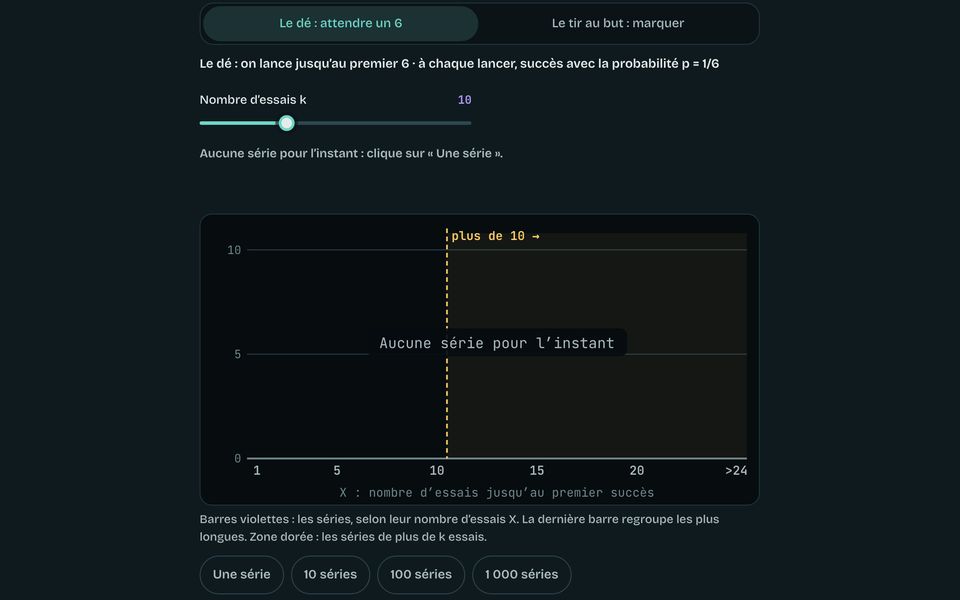
What they will do
- 1DiscoverTrying again until the first success
- 2UnderstandThe formula for each bar, and the expected value
- 3Go furtherChance has no memory
8 missions to complete, level by level.
Already have an account? Sign in
Teacher? A free 2-month trial for your class. Write to us
- Card payment, on Stripe’s secure page
- No ads, no data sold
- Data stored in France